Manufacturing ERP for Three Arrow Plastics
Guru ERP across production, inventory, procurement, finance and HR on a single facility, configured to the process the plant already ran.
- Client
- Three Arrow Plastics Factory Co
- Location
- Riyadh, Saudi Arabia
- Industry
- Manufacturing
- Project type
- Manufacturing ERP
- Service
- ERP Software Development
- Status
- In production
- Result
- One set of numbers for the floor and the office.
The client
Three Arrow Plastics Factory Co runs a plastics production facility in Riyadh. Production, inventory, procurement, finance and HR all happen inside one building and inside one shift pattern, which is what makes the reconciliation problem below a daily one rather than a monthly one.
The challenge
Production planning, inventory, procurement, finance and HR each lived somewhere different, and none of them agreed.
Objectives
- Put the floor and the office on the same numbers, at the same time.
- Replace the reconciliation step between production output and stock on hand.
- Keep the plant running throughout, with a way back at every stage.
- Configure to the process the plant already runs, rather than to a reference model.
Built on Guru ERP, a platform we own and operate rather than resell.
What we built
Guru ERP was configured to the plant rather than the plant to Guru ERP. The rollout ran module by module: production and inventory first, because that is where the disagreement started, then procurement, then finance and HR.
Each module went live behind a switch that could be thrown back. A plant that cannot stop cannot accept a migration that only works forwards, and a rollback that has never been rehearsed is not a rollback.
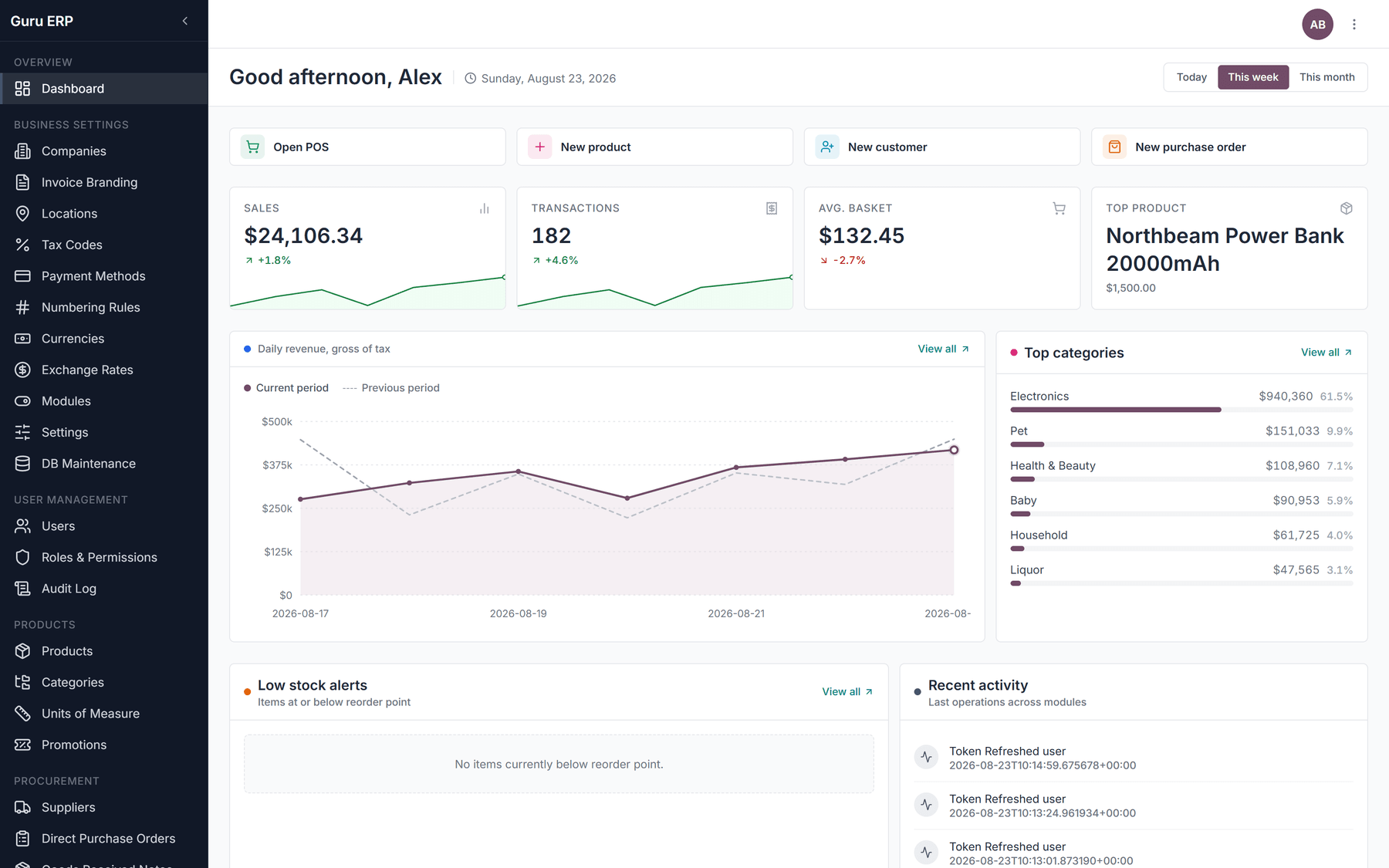
What it does, in production.
Production planning
Work orders, routing and output booked against the plan on the floor rather than reconstructed afterwards.
Inventory
Raw material, work in progress and finished goods on one ledger, moved by the same events that move the physical stock.
Procurement
Requisition through to receipt, with the receipt closing the loop against the stock record instead of a second entry.
Finance and accounts
The general ledger fed from operational events, so the month-end close starts from data the floor already agreed with.
HR and payroll
Attendance and shift records against the same employee master the production booking uses.
Operational reporting
The same figures for the supervisor and the owner, drawn from one source rather than assembled per audience.
The shape of the system.
One database, one employee master, one item master. Most of what makes an ERP disagree with itself is a second copy of a definition somebody needed on a Tuesday.
The integration map, the data model and the deployment topology are covered in technical review under NDA rather than on a public page. The shape of the system is described here; the detail is a conversation, not a download.
How it was delivered.
Discovery ran on the floor rather than in a meeting room: the workaround on a supervisor’s desktop is the requirement nobody wrote down, and a replacement that ignores it gets worked around within a month.
The architecture was written down and signed before the build started. Every release since has gone out under the same three gates the rest of our work uses: architecture review, engineering review, production approval.
Engineering challenges
A migration that had to work backwards
Cutting over a plant on one date is a bet. Running module by module means every module has to be correct while the modules around it are still the old system, which is a harder engineering problem and a much smaller business risk.
Two industries on one codebase
The same build runs at a trading company in Saudi Arabia. Keeping configuration out of the code is what lets one codebase serve two industries without either deployment becoming a fork.
What changed.
- One set of numbers for the floor and the office.
- The system is in production and we are still the ones supporting it.
No percentage appears on this page. Nobody has metered the before state, so any figure we published would be a guess with a decimal point on it. If Three Arrow Plastics ever shares a measured number, it goes here with its method and its date beside it.
Engagements next to this one.
You do not need to arrive with a perfect technical specification.
Start with the problem. Tell us what is slowing the business down, what you want to build, or where the current system is failing. We will tell you the shortest path forward, including when that path is not us.
Start your build