Factory-grade operational control for a trading operation.
Sales, procurement, accounts, HR and tax on one system, under whichever regulatory regime you actually trade in.
What is hard about this sector, before anybody writes software.
If a line below would still be true had we never worked in this sector, it is not specific enough to be on the page.
Margin is known too late
What a deal actually made is worked out after it closed, from three places, by one person.
Tax handled after the fact
VAT is reconciled at period end rather than resolved on the invoice, so errors are found by an accountant instead of by the system.
Stock and cash are separate stories
What is on hand and what is owed on it live in different systems that agree monthly.
Growth means another spreadsheet
Each new line or territory is absorbed by adding a file rather than by extending a system.
Capabilities, in the order they matter.
Sales, procurement, accounts and tax on the operational control a factory system gives, under a different regulatory regime.
Sales
Quotation through to invoice with tax resolved per line rather than applied to a total.
Procurement
Requisition to receipt against a trading item master, closing the loop on stock as goods arrive.
Accounts
Ledger entries generated by the operational events that caused them, not keyed in behind them.
Tax and localisation
Configuration rather than code, so a rate or rule change is a setting an accountant can be shown before it goes live.
HRM
One employee master shared with the rest of the system.
Operational reporting
Stock, margin and receivables drawn from the same data the invoices came from.
Systems running in this sector.
Derived from the engagement record, so this section cannot list work that is not in it.
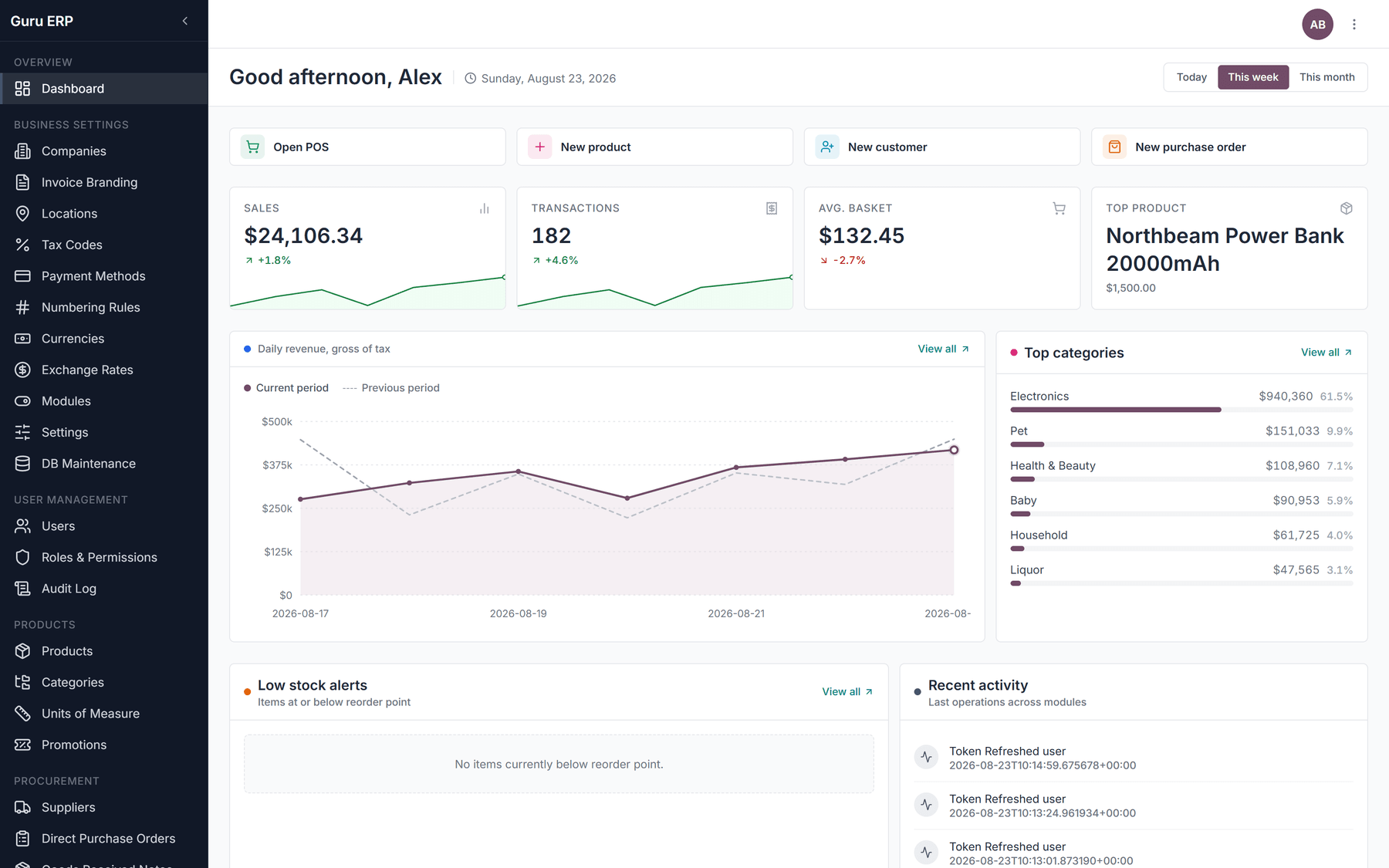
What changes about security in this sector.
Commercial terms are the sensitive material in a trading business, and the access model is built around that: who may see cost against price, and who may change a price after it has been quoted. Both are roles that exist in the business before they are roles in the software.
DevTechGuru holds no security or industry certification, and no page on this site claims one. Where a regime applies it is named as your obligation and as a design constraint we build inside. Ownership, handover and AI governance covers what a procurement reviewer usually asks next.
Technology
- Backend
- PythonDjangoFastAPINode.js
- Frontend
- ReactTypeScriptNext.jsDesign systems
- Data
- PostgreSQLMySQLRedisData modelling
- Cloud
- AWSDockerCI/CDInfrastructure as code
Questions we get asked.
Questions this sector asks that the others do not.
Do you handle VAT in the Gulf?
UAE VAT is live in the Dubai deployment and is handled as configuration rather than as code, so a rate or rule change is a setting rather than a release. Ask us about the specific regime you trade under before assuming it is covered.
Is the trading version a different product?
No. It is the same build as the manufacturing deployment with different configuration, which is deliberate: a fork per industry is the cheapest decision at the start and the most expensive one by year three.
Where to go next
You do not need to arrive with a perfect technical specification.
Start with the problem. Tell us what is slowing the business down, what you want to build, or where the current system is failing. We will tell you the shortest path forward, including when that path is not us.
Start your build