The chair, the stock room and the ledger on one record.
Customers, staff, services, billing, inventory, suppliers and the accounts for a salon or spa, in one platform.
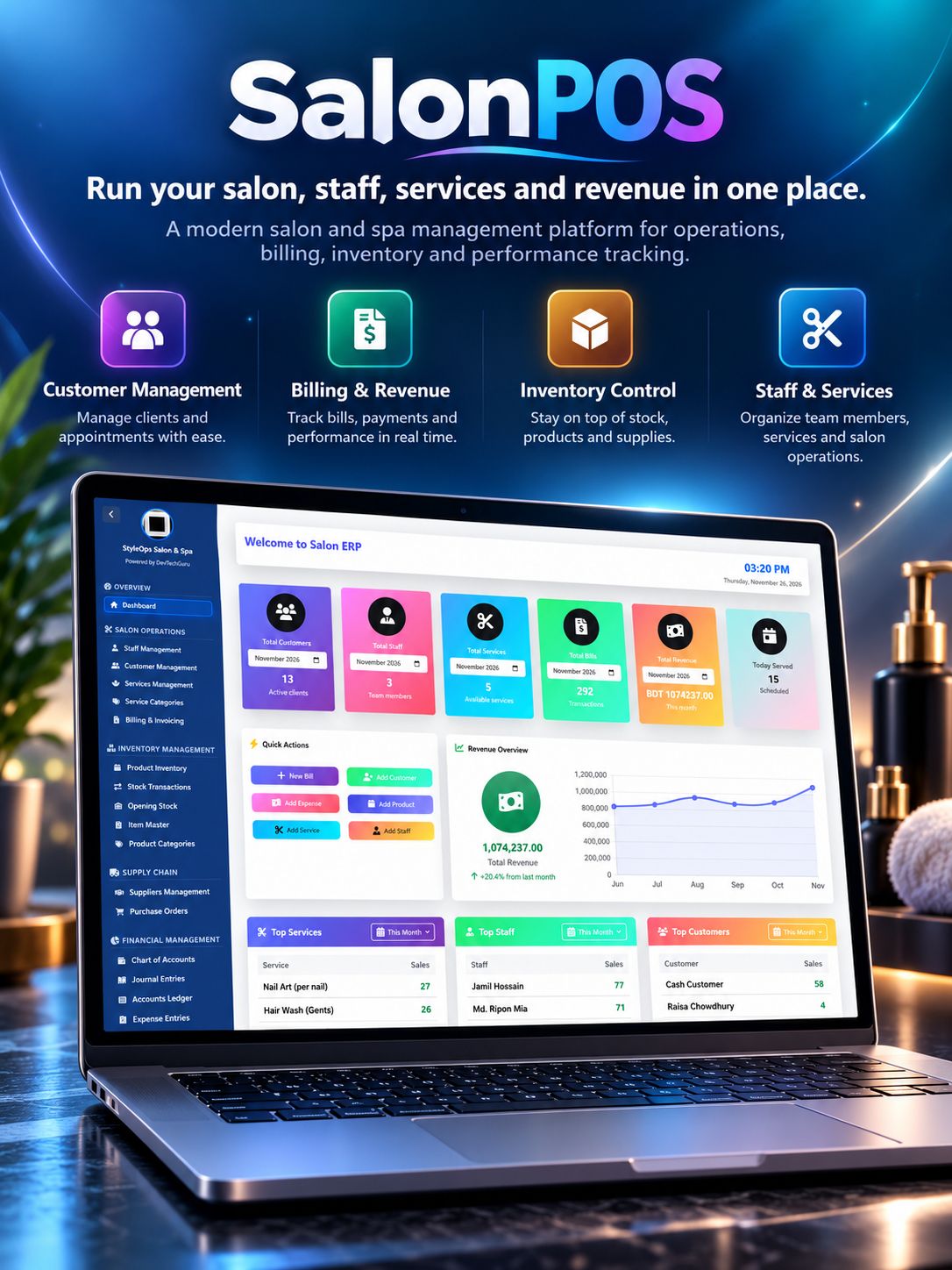
A salon run across five tools
Appointments in one place, bills in another, stock in a spreadsheet and the accounts with whoever does them at month end. Each is right on its own and none of them agrees with the others, which is why the revenue figure is only trusted after somebody has reconciled it.
The cost lands on the owner, who cannot say which services earn the most or which member of staff is carrying the week without building the answer by hand.
One record behind the desk and the dashboard
Salon POS keeps customers, staff, services, bills, stock, suppliers and the ledger in one system. A bill raised at the desk is in the revenue figure, against the staff member and the service, without being keyed in a second time.
The owner’s dashboard is not a separate report. It is the same record, read as totals, a revenue trend and the top services, staff and customers.
What it does today.
Everything listed is something the software does now. Nothing on this page is a roadmap item, and there is no roadmap on it either.
Customer management
Clients and their history held against the bills they generate, so the customer list is built by trading rather than typed in afterwards.
Billing and invoicing
A bill raised from the dashboard in one step, with payments tracked against it.
Services
A service catalogue with categories, so what is sold and what it earns are read off the same list.
Staff
Team members held as records, with sales attributed to the person who delivered the service.
Inventory
Products with an item master, categories, opening stock and the transactions that move it.
Suppliers and purchasing
Suppliers and purchase orders alongside the stock they replenish.
Financial management
A chart of accounts, journal entries, an accounts ledger and expense entries in the same system as the sales.
Dashboard
Customers, staff, services, bills and revenue as totals, a revenue trend over time, and the top services, staff and customers for the period.
How it is put together.
One database behind both surfaces. The front desk and the dashboard are views of the same records, which is what stops the revenue figure and the till disagreeing.
The integration map and the deployment topology are covered in technical review under NDA rather than on a public page.
What actually gets attacked.
A salon platform holds client contact details, appointment history and what each member of staff earns for the business. Staff earnings and the accounts are not information every user of the front desk should see, so what each role can open is decided before the screens are built rather than hidden afterwards.
Ownership, handover and AI governance covers what a procurement or security reviewer usually asks next.
Why there is no figure here.
No deployment, customer-count or revenue figure is published for this platform, and the numbers in its product artwork should not be read as ones. If a client agrees to share a result it goes on a case study with its method and its date beside it.
Engagements built on this platform.
Retail
Classic Cut Boutique Salon
Salon POS running haircuts, treatments, beauty services and product sales through one connected system.
Technology
- Frontend
- ReactTypeScriptNext.jsDesign systems
- Backend
- PythonDjangoFastAPINode.js
- Data
- PostgreSQLMySQLRedisData modelling
- Cloud
- AWSDockerCI/CDInfrastructure as code
Questions we get asked.
What buyers of this platform ask before a demo.
Does it cover the accounts as well as the till?
Yes. A chart of accounts, journal entries, an accounts ledger and expense entries sit in the same system as billing and inventory, so the sales and the books are not kept in two places.
Can it track stock and suppliers?
Yes. Products have an item master, categories, opening stock and stock transactions, and suppliers and purchase orders sit beside them.
Where to go next
You do not need to arrive with a perfect technical specification.
Start with the problem. Tell us what is slowing the business down, what you want to build, or where the current system is failing. We will tell you the shortest path forward, including when that path is not us.
Start your build