The resident sees the same record the operator does.
Visitor movement, resident services, billing and operational communication across multi-tower estates, on one platform.
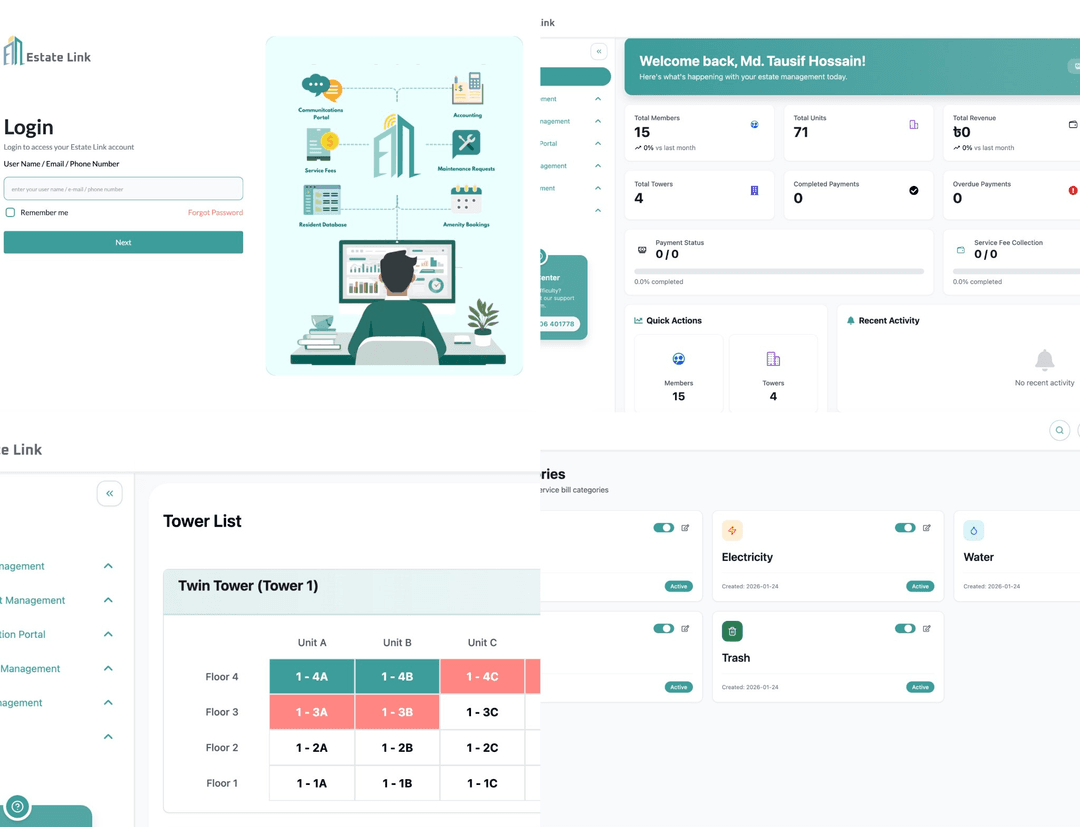
Four tools and a group chat
Visitor movement, resident services, billing and operational messaging each end up somewhere different, and the group chat becomes the integration layer between them. Nothing is searchable and nothing has a history.
The second problem is asymmetry. Billing and service progress exist in the operator’s system and reach the resident as a message, which is where almost every dispute starts.
One record, two audiences
Visitor movement, resident services, billing and operational communication across multi-tower estates, on one platform.
The constraint is who gets to see it. Billing and service tracking are visible to the resident, not only to the operator, which is the difference between a management tool and a service.
What it does today.
Everything listed is something the software does now. Nothing on this page is a roadmap item, and there is no roadmap on it either.
Property operations
One platform across an estate rather than one deployment per building.
Visitor management
Movement in and out recorded as events at the gate, searchable afterwards without reading a book.
Resident services
Requests raised, tracked and closed against a record the resident can see the state of.
Billing
Charges, payments and balances visible to the person who owes them, which removes most of a dispute before it starts.
Maintenance
Faults with a history, so a recurring problem is visible as a recurrence rather than as four unrelated reports.
Operational communication
Announcements and notices inside the system that holds the records they refer to.
Reporting
Movement, service load and receivables from the data the operation already produced.
How it is put together.
One record with two views, rather than an operator system and a resident portal kept in step by a job that runs at night. The resident view is a permission on the record, which is what makes it impossible for the two to disagree.
The integration map and the deployment topology are covered in technical review under NDA rather than on a public page.
What actually gets attacked.
An estate platform holds who lives where and who visited them, which is a different sensitivity from a business record. A resident-facing view exposes that resident’s own record and nothing adjacent to it, and the access model is written before the interface rather than derived from it.
Ownership, handover and AI governance covers what a procurement or security reviewer usually asks next.
Engagements built on this platform.
Real EstateDhaka
A multi-tower estate operator
Property operations and resident experience on one platform.
Technology
- Frontend
- ReactTypeScriptNext.jsDesign systems
- Backend
- PythonDjangoFastAPINode.js
- Data
- PostgreSQLMySQLRedisData modelling
- Cloud
- AWSDockerCI/CDInfrastructure as code
Questions we get asked.
What buyers of this platform ask before a demo.
Can residents see their own billing and service requests?
Yes, and it is the design position rather than a feature toggle. Visibility to the resident is what separates a management tool from a service.
Does it handle more than one tower?
Yes. It is deployed across multi-tower estates as one platform, not as one deployment per building.
Where to go next
You do not need to arrive with a perfect technical specification.
Start with the problem. Tell us what is slowing the business down, what you want to build, or where the current system is failing. We will tell you the shortest path forward, including when that path is not us.
Start your build